You Won’t Believe How Nepal’s Terrain Shapes Patan’s Food
Nestled in the Kathmandu Valley, Patan rises on ancient terraces carved by time and tectonics. I never expected that the city’s dramatic slopes and brick-lined alleys would shape its flavors so deeply. From steamed dumplings sold at mountain-adjacent stalls to spice blends dried on sunbaked rooftops, every bite tells a story of elevation, soil, and tradition. This is food forged by terrain—honest, bold, and unforgettable. The land does not merely feed the people; it instructs them. In Patan, cooking is not just an art or a necessity—it is a dialogue between human hands and the earth’s contours, where altitude dictates aroma, slope influences spice, and centuries-old geology lives on in clay pots and copper bowls. To taste Patan is to understand its landscape, one morsel at a time.
The Lay of the Land: Understanding Patan’s Unique Topography
Patan, also known as Lalitpur, rests within the bowl-like embrace of the Kathmandu Valley, cradled by the lower Himalayan range. Situated on a gently sloping plateau that tilts from the northeastern hills toward the southern plains, the city’s elevation ranges between 1,200 and 1,400 meters above sea level. This subtle but significant incline is no accident of nature—it is the result of tectonic shifts over millennia, river sediments deposited by the ancient Bagmati, and the slow sculpting force of monsoon rains. These geological processes created a terrain that is neither flat nor mountainous, but somewhere in between—a land of terraces, natural drainage paths, and layered settlements.
This unique topography has shaped how Patan was built and how it functions today. Unlike grid-planned cities, Patan evolved organically, with homes, temples, and market lanes following the natural fall of the land. Raised courtyards and stepped alleyways are not merely aesthetic; they serve practical purposes such as preventing waterlogging during heavy rains and improving airflow in densely packed neighborhoods. The city’s historic core, a UNESCO World Heritage Site, features a network of narrow brick paths that climb and descend with the land, guiding foot traffic like veins through the urban body. These pathways are more than routes—they are reflections of a deep understanding of the earth’s form.
What may seem like a minor variation in elevation has profound effects on daily life. Water flows from higher zones to lower ones, determining where kitchen gardens can thrive and where wells are most productive. Fuel and food must be carried uphill, influencing how much families store and how often vendors make their rounds. Even sound travels differently across the slopes—calls from street sellers echo off brick walls, their voices carrying farther in some lanes than others. In this way, the terrain is not just a backdrop to life in Patan; it is an active participant, shaping routines, rhythms, and relationships with the environment.
From Soil to Spice: How Terrain Influences Local Ingredients
The richness of Patan’s cuisine begins long before the first pot is heated—it starts beneath the surface, in the fertile alluvial soils left behind by ancient river systems. These mineral-laden grounds, replenished by seasonal runoff from the surrounding hills, are ideal for growing a variety of crops that define the local palate. Red rice, known locally as *masino*, thrives in the cooler, well-drained upper terraces. Its nutty flavor and deep color are direct results of the altitude and soil composition, making it a staple in both everyday meals and ceremonial dishes.
Equally important is finger millet, or *kodo*, a hardy grain that grows well on marginal slopes where other crops might fail. High in fiber and nutrients, *kodo* is ground into flour for porridge, flatbreads, and fermented beverages. Mustard greens, another terrain-adapted plant, flourish in the valley’s temperate microclimates. Their peppery bite enhances lentil soups and vegetable stir-fries, adding a layer of complexity that reflects the land’s vitality. These ingredients are not imported luxuries; they are born of the local ecosystem, shaped by sun, slope, and seasonal water flow.
On the outskirts of Patan, small-scale farmers maintain terraced plots where kitchen gardens yield fresh turmeric, ginger, garlic, and chilies. These spices are not only culinary essentials but also natural preservatives, crucial in a region where refrigeration is limited and seasonal abundance must be stored. Sun-drying is a common practice—strings of red chilies hang from eaves, their colors bright against the brick walls, absorbing the high-altitude sunlight that intensifies their heat. Fermentation, too, plays a key role: soybeans are transformed into *kinema*, a pungent, protein-rich condiment that develops its distinctive flavor through slow bacterial action in warm, humid conditions found naturally in Patan’s courtyards.
The connection between terrain and taste is not abstract—it is measurable in the way ingredients grow, how they are harvested, and when they appear on the table. Monsoon rains dictate planting cycles; winter frosts determine storage methods; spring thaws signal the return of fresh herbs. Every meal is, in essence, a seasonal report, a direct reflection of what the land can offer at any given moment. This deep attunement to natural rhythms ensures that Patan’s food is never static; it evolves with the earth itself.
Street Food on the Slopes: Mobility and Market Culture
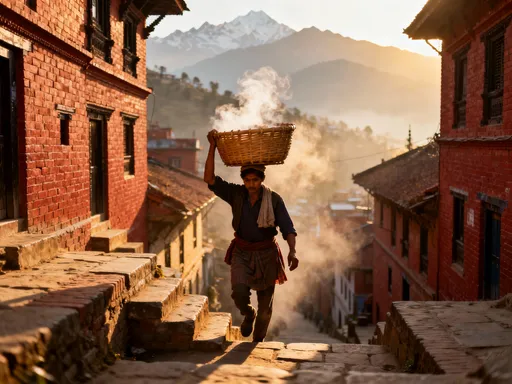
In Patan, food does not wait to be discovered—it moves. Vendors traverse the city’s sloped alleys with remarkable agility, balancing steaming baskets on their hips or carrying clay pots on their heads. These mobile kitchens are a direct response to the city’s topography. With vehicles unable to access many narrow lanes, human-powered delivery becomes not just practical but essential. The design of street food itself reflects this reality: portable, handheld, and easy to eat while standing or walking on uneven ground.
One of the most iconic examples is *sel roti*, a ring-shaped rice bread that is deep-fried to a golden crisp. Its circular form is not just symbolic; it makes the bread easy to carry and share. Wrapped in banana leaves or placed in woven baskets, *sel roti* can be transported up steep staircases without breaking. Similarly, *chatamari*, often called “Nepali pizza,” is a thin, crepe-like rice flour pancake topped with minced meat, eggs, or vegetables. Baked quickly on a hot griddle, it is light enough to eat on the go and resilient enough to survive a climb to a hillside home.
Market culture in Patan is equally shaped by elevation. Instead of sprawling bazaars, the city relies on decentralized nodes—small clusters of stalls that gather near temples, crossroads, or water spouts. These micro-markets emerge in response to foot traffic patterns, which are themselves dictated by the lay of the land. Pilgrims descending from hilltop shrines often stop at roadside vendors for warm *momo* dumplings, filled with spiced buffalo or vegetable mixtures. Laborers returning from construction sites on higher ground seek out steaming bowls of *dal bhat*, the lentil and rice combo that fuels the city’s workforce.
The placement of eateries is also strategic. Many are tucked into courtyards or built into the lower levels of multi-story homes, where they benefit from natural shade and protection from wind. Temple-adjacent stalls enjoy steady patronage, especially during festivals, when offerings are distributed and communal meals are prepared. These spaces are more than places to eat—they are social hubs, where news is exchanged, families gather, and traditions are passed down. In a city where every step requires effort, these rest points become vital oases of nourishment and connection.
Cooking at Altitude: Challenges and Adaptations in the Kitchen
At over 1,200 meters above sea level, Patan exists in a zone where the air is thinner and water boils at a lower temperature—approximately 95°C (203°F) instead of 100°C (212°F). This seemingly small difference has significant implications for cooking. Boiling and steaming, two of the most common methods in Nepali cuisine, require longer times to achieve the same results as at sea level. Lentils that might soften in twenty minutes elsewhere can take nearly twice as long in Patan’s kitchens. This reality has led to practical adaptations that are now woven into the culinary tradition.
Local cooks compensate by starting meals earlier, using heavier pots that retain heat, and relying on slow, steady flames. Clay ovens, known as *chulos*, are often elevated on brick platforms or shielded by low walls to protect them from the wind that sweeps down from the hills. These ovens burn dried dung, wood, or agricultural waste—fuels that are readily available but must be conserved. Efficiency is not just economical; it is environmental. Every log, every dried leaf, carries the weight of effort—collected, carried, and stored with care.
As a result, Patan’s cuisine favors dishes that benefit from long, slow cooking. Hearty stews like *tarkari*—vegetable curries simmered with turmeric, cumin, and mustard oil—develop deeper flavors over time. Lentil soups are thickened with rice flour or mashed vegetables to improve texture and nutrition. Even fried foods like *pakoras* are often par-cooked and finished just before serving, minimizing fuel use while preserving crispness. These techniques are not born of convenience but of necessity, refined over generations to make the most of limited resources.
Another adaptation is the use of pressure cookers, which have become common in both homes and street kitchens. By trapping steam and increasing internal pressure, these pots reduce cooking time significantly, making them ideal for preparing beans, rice, and meats efficiently. Yet, even with modern tools, many families still rely on traditional methods, especially during festivals or when cooking for large groups. The rhythm of the kitchen—slow, deliberate, attentive—mirrors the pace of life in a city built across gradients, where haste is often impractical and patience is a virtue.
Sacred Kitchens: Food and Ritual in Patan’s Courtyards
In Patan, food is not only sustenance—it is sacred. At the heart of the city’s spiritual life are the *bahals*, ancient Buddhist monastery complexes that double as community centers and culinary sanctuaries. Within their walled courtyards, monks and lay families prepare *prasadam*, food offerings blessed by deities and shared among worshippers. These meals are not generic; they are deeply tied to the land. Rice is sourced from nearby terraces, vegetables from kitchen gardens, and spices from sun-dried harvests—all elements that reflect the season and the terrain.
Festivals in Patan are inseparable from food. During *Indra Jatra* or *Bisket Jatra*, entire neighborhoods come together to cook in open-air kitchens. Large cauldrons are set over wood fires, bubbling with lentils, rice, and spiced vegetables. The timing of these meals is often linked to agricultural cycles—harvest festivals celebrate the arrival of new grain, while spring rituals mark the return of fresh greens. Even the shape of the food carries meaning: *yomari*, a steamed dumpling filled with molasses and sesame, is shaped like a rice grain, symbolizing abundance and gratitude for the earth’s gifts.
After mountain pilgrimages, returning devotees are welcomed with communal feasts. These meals are more than celebrations—they are acts of restoration, offering warmth and energy after the physical strain of climbing. Dishes are chosen for their nourishing qualities: hot soups to warm the body, carbohydrate-rich breads to replenish energy, and spiced teas to aid digestion. The location of these feasts—often in elevated courtyards with views of the valley—adds to their significance. Here, food, faith, and landscape converge, creating a holistic experience that feeds both body and spirit.
The sacred kitchen is also a place of transmission. Elders teach children how to grind spices, shape dumplings, and recite blessings over food. Recipes are not written down but passed through practice, ensuring that each generation maintains its connection to the land and its traditions. In this way, the *bahal* is not just a religious site; it is a living archive of culinary wisdom, where terrain, culture, and devotion are served on every plate.
Hidden Eateries: Finding Flavor in Elevated Corners
While Patan’s main squares and heritage sites draw tourists, some of its most authentic flavors lie off the beaten path—in quiet lanes that climb toward the city’s upper edges. These elevated corners, often overlooked, host family-run eateries that have operated for decades, if not generations. Reaching them is part of the experience: a slow ascent through narrow alleys, past prayer wheels and flower-filled courtyards, until the scent of roasting cumin and simmering lentils guides the way.
One such spot might serve *yomari* during the winter months, freshly steamed and served with a side of spiced yogurt. Another could specialize in wild herb curries, made with greens foraged from nearby hillsides—bitter, aromatic, and deeply medicinal. Spiced lentil balls, known as *bara*, are often found in ridge-side stalls, where they are fried to order and served with tangy tamarind chutney. These dishes are not designed for mass appeal; they are expressions of place, shaped by access to local water sources, firewood, and trade routes that have existed for centuries.
What sets these eateries apart is not just the food but the context. Sitting on a low wooden bench, looking out over the valley, one feels the altitude in the crisp air and the quiet. There are no menus, only what the kitchen has prepared that day—whatever the land has provided. The absence of signage or online presence is not a drawback; it is a mark of authenticity. These are not destinations for influencers or trend-chasers; they are sanctuaries for those who seek a deeper connection to place.
Travelers who make the climb are often rewarded with more than a meal. They gain insight into how elevation shapes not just flavor but experience—the effort of ascent mirrored in the richness of the food, the stillness of the setting amplifying the taste. In these hidden corners, Patan reveals its quietest truths: that the most meaningful journeys are not always the easiest, and that the best flavors are often found where the path rises.
Sustainable Bites: The Future of Food in a Changing Landscape
As Patan grows, its terrain-based food culture faces new pressures. Urban expansion is encroaching on the city’s agricultural fringes, replacing terraced fields with concrete buildings. Climate change is altering rainfall patterns, making irrigation less predictable and affecting crop yields. Younger generations are moving away from farming, drawn to city jobs and modern lifestyles. These shifts threaten not just the availability of traditional ingredients but the knowledge systems that sustain them.
Yet, there is hope. Community initiatives are emerging to protect Patan’s edible heritage. Urban gardening projects are reviving rooftop and courtyard cultivation, allowing families to grow herbs, chilies, and leafy greens even in dense neighborhoods. Schools are teaching children about traditional crops and cooking methods, ensuring that knowledge is not lost. Some neighborhoods have formed cooperatives to manage water spouts and maintain shared kitchen gardens, reinforcing collective responsibility for natural resources.
Eco-conscious street vendors are also adapting. Some now use solar-powered cookers or biodegradable packaging, reducing their environmental footprint. Others emphasize local sourcing, proudly stating that their rice comes from nearby terraces and their spices from sun-dried harvests. These efforts are not just about sustainability; they are acts of cultural preservation, affirming that food is more than fuel—it is identity.
Travelers, too, have a role to play. By choosing to eat at family-run stalls, asking about ingredient sources, and respecting local customs, visitors can support a food system rooted in place. Tasting mindfully—savoring not just flavor but story—helps sustain the very traditions that make Patan unique. Every meal becomes a small act of conservation, a way to honor the land and those who tend it.
Conclusion: Where Earth Meets Appetite
Patan’s cuisine is not accidental. It is the product of a deep, enduring conversation between people and place—a dialogue written in the tilt of the land, the richness of the soil, and the rhythm of the seasons. From the way *momo* are steamed at altitude to how *sel roti* are carried up steep alleys, every element of the city’s food culture bears the imprint of its terrain. To eat in Patan is to engage with geography on the most intimate level: through taste.
Visitors are often drawn to the city’s golden temples and intricate woodcarvings, but the true essence of Patan lies on its plates and in its pots. The red rice, the fermented soy, the sun-dried chilies—they are not just ingredients; they are chapters in a story that began long before tourism, shaped by generations of adaptation and resilience. To move beyond monuments and savor the edible landscape is to experience travel in its fullest sense.
So let your journey be guided not only by sight but by appetite. Climb the alleys, follow the scent of cumin and smoke, and sit where the locals sit. Let each bite remind you that food is never just food—it is memory, identity, and connection. In Patan, the earth speaks through flavor. All you need to do is listen.